Cyber Security Training
The Cyber Security Training Program provides hands-on training in key areas like network security, ethical hacking, penetration testing, and incident response. Participants will learn to use security tools and techniques to protect systems and data from cyber threats through real-world simulations.
Ideal for IT professionals and those interested in cyber security, this program offers flexible learning, expert mentorship, and an industry-recognized certification, preparing learners to effectively defend against cyber threats.

Why Choose Cycronet?
Expert-Led Training
Industry Experience
Industry Relevent Curriculum
Hands-On Projects
LMS Access
Comprehensive Tools and Technologies
professional certifications
Career Support
TRAINING PATH
Introduction to cybersecurity
- What is Cybersecurity?
- Importance and Applications of Cybersecurity
- Types of Cyber Threats
- Cybersecurity Domains
Fundamentals of Networking
- Basics of Networking
- Understanding Firewalls and VPNs
- Network Protocols and Layers
- Network Security Basics
Operating System and Security
- Introduction to Windows, Linux, and Mac OS Security Features
- File Systems and Permissions
- Securing Endpoints
- Basics of Virtualization and Sandbox Environments
Cryptography Fundamentals
- Basics of Cryptography and Encryption Algorithms
- Symmetric vs Asymmetric Encryption
- Hashing Algorithms
- Public Key Infrastructure (PKI) and Digital Certificates
Web and Application Security
- Common Web Vulnerabilities
- Secure Software Development Life Cycle (SDLC)
- Introduction to Web Application Firewalls (WAFs)
- Authentication and Authorization Mechanisms
Ethical Hacking and Pen Testing
- Basics of Ethical Hacking and Pen Testing
- Reconnaissance and Information Gathering Techniques
- Exploiting Vulnerabilities
- Tools for Penetration Testing
Incident Response and Forensics
- Introduction to Incident Response Lifecycle
- Identifying and Containing Security Breaches
- Basics of Digital Forensics and Evidence Collection
- Creating Incident Response Plans and Playbooks
Cybersecurity Tools and Frameworks
- Basics of Ethical Hacking and Pen Testing
- Reconnaissance and Information Gathering Techniques
- Exploiting Vulnerabilities
- Tools for Penetration Testing
SKILLS COVERED
Operating Systems Fundamentals
System Architecture
Virtual Memory Concepts
Networking Concept
Network Protocols
Firewalls and Security Protocols
SIEM Systems
MITRE Framework
Identity Management IAM
Network Forensics
Threats and Vulnerabilities
Ethical Hacking
Penetration Testing
Secure Coding Practices
Vulnerability Assessment
Incident Response
Prompt Engineering
Risk Management
Industry Projects
Vulnerability Scanner

Develop a tool that scans systems or networks for security vulnerabilities. Use algorithms to detect common security flaws, such as outdated software versions or misconfigurations, and provide recommendations for mitigation.
The key component include
1.User-Friendly Interface
2.Secure and Scalable Backend
3.Essential Functional Components
4.Enhanced Vulnerability Detection Features
5.Third-Party Tools and Libraries
6.Modular System Design
Technologies Python/Java (for backend development), React/Angular (for frontend development), MySQL/MongoDB (for vulnerability database), Nmap/OpenVAS/Metasploit (for scanning engines), Elasticsearch/Kibana (for reporting and analytics), and AWS/GCP/Azure (for cloud hosting).
Outcome A Vulnerability Scanner enables organizations to proactively identify and address security flaws, reducing the risk of data breaches and cyberattacks. It strengthens overall cybersecurity posture, ensuring compliance with industry standards and protecting critical assets.
Firewall Simulation

Create a simulation of a firewall that can filter incoming and outgoing network traffic based on predefined security rules. Implement features such as packet filtering, intrusion detection, and real-time traffic analysis.
The key component include
1.User-Friendly Interface
2.Secure and Scalable Backend
3.Essential Functional Components
4.Enhanced Traffic Control Features
5.Third-Party Tools and Libraries
6.Modular System Design
Technologies Python/Java (for backend development), React/Angular (for frontend development), SQLite/MySQL (for database), Wireshark/Snort (for packet analysis and intrusion detection), Docker (for containerized simulation), and AWS/GCP/Azure (for cloud hosting).
Outcome A Firewall Simulation helps users understand network security principles, experiment with firewall rules, and evaluate the impact of policies on traffic control. It provides hands-on experience in securing networks and enhances preparedness against cyber threats.
Password Cracking and Strength Evaluation

Build a tool to assess the strength of passwords by attempting to crack them using brute force or dictionary attacks. Evaluate password security based on length, complexity, and resistance to common cracking methods.
The key component include
1. Data Collection & Preprocessing
2. Feature Engineering
3. Modeling & Training
4. Imbalanced Data Handling
5. Model Evaluation & Optimization
6. Real-Time Fraud Detection System
Technologies Python, Scikit-learn, XGBoost, Keras, TensorFlow, SMOTE, Real-time data integration (APIs).
Outcome A fraud detection system that helps credit card companies identify and prevent fraudulent transactions, protecting customers and minimizing financial losses.
Secure File-Sharing Application

Design a secure file-sharing application that encrypts files before transmission and ensures privacy during storage. Implement encryption algorithms (e.g., AES) and secure authentication protocols to protect data integrity.
The key component include
1. Data Collection & Preprocessing
2. Feature Engineering
3. Demand Forecasting
4. Price Optimization Models
5. Dynamic Pricing Strategy
6. Model Evaluation & Optimization
7. Dashboard & Reporting
Technologies Python, Scikit-learn, XGBoost, ARIMA, Prophet, Reinforcement Learning, Tableau, Plotly Dash.
Outcome A price optimization system that helps airlines set competitive prices, maximize revenue, and enhance customer satisfaction by adjusting prices based on real-time demand and market conditions.
Phishing Attack Detector

Develop a system that can detect phishing attempts in emails or websites. Use machine learning models to analyze patterns in URLs, email content, or web page characteristics to classify phishing attempts.
The key component include
1.User-Friendly Interface
2.Secure and Scalable Backend
3.Essential Functional Components
4.Advanced Threat Detection Features
5.Third-Party Tools and Libraries
6.Modular System Design
Technologies Python/JavaScript (for backend development), React/Angular (for frontend development), TensorFlow/PyTorch (for machine learning), MongoDB/PostgreSQL (for databases), Beautiful Soup/Scapy (for HTML and network analysis), and AWS/GCP/Azure (for cloud hosting).
Outcome The Phishing Attack Detector helps organizations and individuals identify and block phishing attempts, thereby protecting sensitive information. It enhances cybersecurity awareness and reduces the risk of financial and reputational damage caused by phishing attacks.
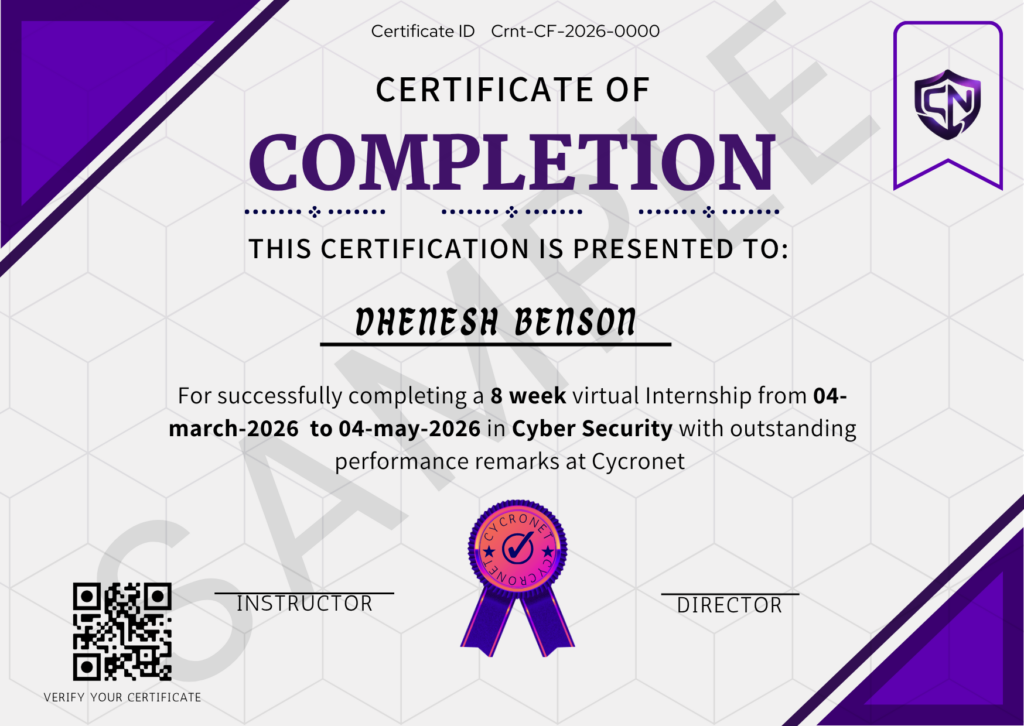
CERTIFICATIONS


Pricing plan
Starter
( Project-Based )
₹ 499
Features
• Real-world project tasks
• No lectures or tutorials
• Self-paced execution
• Certificate after completion
• Tag us to verify your work
Pro
( Recorded + Projects)
₹ 999
Features
• Recorded lectures
• Step-by-step project tutorials
• Learn + build simultaneously
• Flexible schedule
• Certificate included
Premium
( Live + Mentorship )
₹ 2,499
Features
• Live interactive classes
• Full recorded access
• Doubtsolving
• Guided project building
• Strong portfolio + certificate
Companies Hire these skills











Frequently Asked Questions
What is cybersecurity training?
A Cyber Security training program provides individuals with the knowledge and skills to protect systems, networks, and data from cyber threats and attacks. It typically covers topics such as network security, cryptography, ethical hacking, threat assessment, incident response, and compliance standards. The program often includes practical exercises, simulations, and real-world scenarios to build hands-on expertise, preparing individuals for careers in cybersecurity, ethical hacking, and related fields.
What does a cybersecurity specialist do?
A cybersecurity expert protects systems, networks, and data from unauthorized access, breaches, and cyberattacks. They identify vulnerabilities, implement security measures, and monitor for threats using tools like firewalls, intrusion detection systems, and encryption techniques. They also conduct risk assessments, respond to incidents, and ensure compliance with security standards. Our cybersecurity training program equips individuals with the skills and knowledge needed to excel in these critical tasks
Who are the instructors for this cybersecurity training program?
Our Cybersecurity instructors are highly experienced professionals with in-depth knowledge of the field and a proven track record of success. They possess strong practical skills and a deep understanding of evolving cyber threats.
What will be career path after completing the cybersecurity program online?
After completing an online cybersecurity training program, career paths include roles such as Cybersecurity Analyst, Ethical Hacker, Network Security Engineer, Information Security Specialist, Incident Response Analyst, and Security Consultant. With experience, you can progress to advanced positions like Cybersecurity Manager, Security Architect, or Chief Information Security Officer (CISO)
Which industry use cybersecurity specialist the most?
Cybersecurity is critical across industries such as banking and finance, healthcare, government, retail, technology, and telecommunications. Industries like energy, defense, education, and e-commerce also heavily rely on cybersecurity professionals to protect sensitive data and infrastructure. This cybersecurity certification course is ideal for individuals looking to build a career in these high-demand sectors.
How long is the training?
Our Self-paced and Mentor-led training both last for a period of 1-2 months. Our Advanced training last for a period of 4 months.